How to Get Fit After 40 When You're Stiff and Out of Shape
Stiff, out of shape and not sure where to start? Here's what actually works for men over 40 who want to get back in shape without wrecking themselves. From £97. Axon Fitness.
stewart howard
4/29/20265 min read
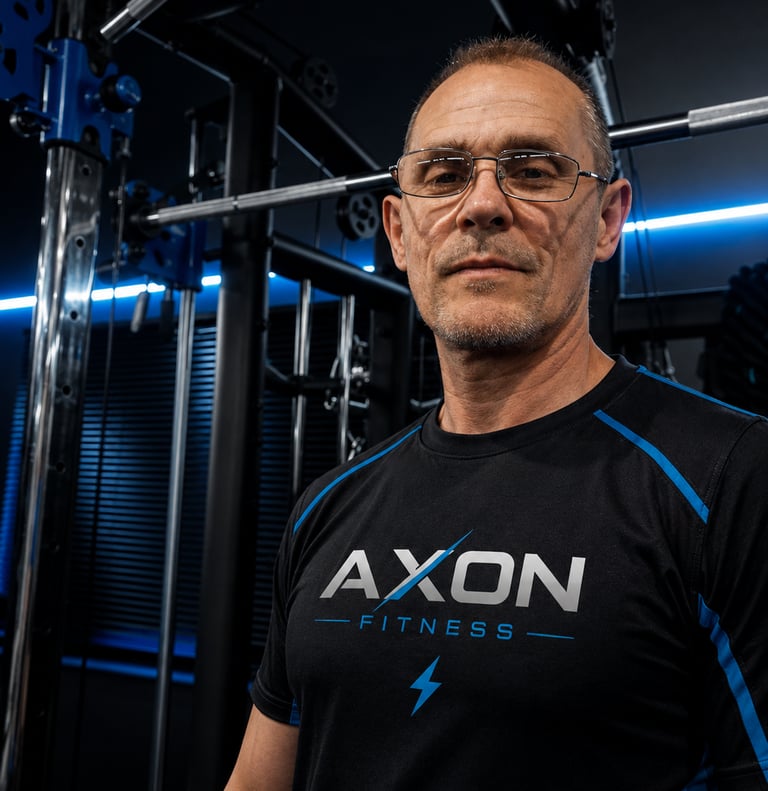
How to Get Fit After 40 When You're Stiff and Out of Shape
Feeling stiff, out of shape and not sure where to start? Here's what actually works for men over 40 who want to get back in shape without wrecking themselves.
Why Getting Fit After 40 Feels So Hard (And Why It's Not Too Late)
You remember being fitter. You moved easier, recovered quicker, and didn't think twice about getting up off the floor. At some point, somewhere between the job, the family, and just getting on with life, that changed.
Now you're stiff in the morning. You're carrying weight you didn't used to carry. You get tired quicker than you should. And every time you think about doing something about it, the whole thing feels overwhelming, because the advice you find online seems to be written for someone half your age.
I hear this all the time. And I want to be straightforward with you: it's not too late, and it's not as complicated as the fitness industry makes it look. But you do need to understand what's actually happening in your body after 40, because it changes what you should be doing about it.
What Actually Changes After 40
There are real physiological changes that happen as you get older. None of them are catastrophic. But ignoring them is why a lot of men over 40 try to get back in shape and end up hurt, frustrated, or both.
Muscle loss accelerates. From your mid-30s onwards, you lose muscle mass more quickly than you did when you were younger. This is called sarcopenia, and it's one of the main reasons men over 40 feel weaker and more tired without doing anything obviously different. The good news is that strength training directly reverses it. Your body still responds, it just needs the right signal.
Recovery takes longer. A 25-year-old can train hard, sleep badly, and bounce back. You can't, and trying to work on that timeline is a fast route to injury. Rest and recovery aren't optional extras, they're part of the training.
Testosterone drops gradually. Lower testosterone means it's harder to build and hold onto muscle, and easier to accumulate fat around the middle. Again, not a death sentence. Strength training is one of the most effective natural ways to support healthy testosterone levels.
Joints accumulate wear. Decades of work, sport, carrying loads, and just living take a toll on your joints. That stiffness you feel in the morning isn't in your head, it's your body taking longer to warm up than it used to. This means your warm-up matters more than it did at 25, and your training needs to support your joints rather than hammer them.
None of this means you're done. It means you need to train smarter than you did in your 20s, which, honestly, isn't a high bar.
The Biggest Mistake Men Over 40 Make When Getting Back in Shape
Going too hard, too fast.
I've seen it dozens of times. A man in his 40s or 50s decides enough is enough, walks into a gym, and starts training like he's 22. Three weeks later his knees hurt, his back is giving him grief, and he's convinced his body just can't do it anymore.
The body can do it. The problem was the approach.
Your joints and connective tissue, tendons, ligaments, don't adapt as quickly as your muscles do. Your muscles might feel fine after a hard session, but the tendons holding everything together haven't caught up yet. That's where injuries come from when you come back too aggressively after years off.
The other mistake is jumping straight to high-intensity training, circuits, bootcamps, HIIT classes, because it feels like the fastest route to results. For a deconditioned body over 40, high intensity before you've built a foundation is like running before you can walk. It works for a while, right up until something breaks.
Start slower than you think you need to. Build the foundation first. The results still come, and they stick around longer.
How to Start Without Wrecking Yourself
The first four weeks are about building a base, not making up for lost time.
Start with three sessions a week. Not five. Not every day. Three, with rest between each one. Your body does its adapting during recovery, not during the session itself. Give it time to do that.
Keep sessions to 30–40 minutes. A focused 30-minute session done three times a week will change your body. A sporadic two-hour session once a week won't.
Move before you train. Ten minutes of gentle movement before you do anything else, hips, shoulders, spine, makes a significant difference both to how you feel during the session and to your injury risk. Don't skip it.
Use effort levels you can sustain. If you're breathless and can't hold a conversation, you're working too hard for this phase. You want to feel like you've worked, not like you've been through a blender.
This isn't a forever approach, it's a starting approach. After four to six weeks of this, your body is ready for more, and you can push harder. But this is the foundation that makes everything else work.
What to Focus On: Strength, Mobility, and Consistency
These are the three things that actually move the needle for men over 40.
Strength training. Not bodybuilding, functional strength. Squats, hinges, presses, rows. Movements that carry over into real life. This is what preserves muscle mass, supports your joints, keeps your metabolism working, and makes you feel capable again. It's also the single most effective thing you can do for long-term health as you age.
Mobility work. Stiffness is usually a mobility problem, not a damage problem. Regular, consistent mobility work, hips, thoracic spine, shoulders, is what stops you feeling locked up. Ten minutes a day, done consistently over weeks, will change how you move and how you feel more than most people expect.
Consistency over intensity. This is the one that matters most. A moderate session done three times a week, every week, for three months, will deliver results that no amount of sporadic hard sessions can match. The body adapts to what it does repeatedly. Make showing up the habit, and the results follow.
A Simple Starting Point
If you want something to do this week, start here:
- Monday: 30–40 minute full body strength session (3 sets of 5–6 exercises, moderate weight)
- Wednesday: 20 minute mobility session (hips, spine, shoulders)
- Friday: 30–40 minute full body strength session
That's it. Three sessions. Under two hours of total training across the whole week. Done consistently for six weeks, most men notice real changes, less stiffness in the morning, more energy, clothes fitting differently.
It's not complicated. The hard part is starting, and then not stopping when life gets in the way.
Ready to Stop Guessing?
The problem with trying to figure this out alone is that most of what's out there wasn't written for men in their 40s and 50s who've spent decades working hard and want a realistic route back to feeling good in their bodies.
That's exactly who Axon Fitness was built for.
If you want a programme that's designed around where you actually are right now, [message me on WhatsApp ]07481811959 and we'll have a straightforward conversation about what you need. No sales pitch. No generic plan.
Related reading: - [Why Your Back Pain Might Be a Hydration Problem](/why-your-back-pain-might-be-a-hydration-problem)