You Sit for 16 Hours a Day. Here's What That's Doing to Your Body.
Machine operators sit in the cab, the car, the sofa and the bed. Add it up and it's 16+ hours a day. Here's what that's doing to your body and how to stop the damage stacking up.
stewart howard
5/7/20265 min read

You Sit for 16 Hours a Day. Here's What That's Doing to Your Body.
Most machine operators know the cab takes a toll. But here's the thing most people don't stop to add up - the cab is just one part of it.
Run through a typical day:
- Commute to site: 30–60 minutes in the car
- Morning shift in the cab: 4–5 hours
- Lunch break: sitting in the cab or the welfare
- Afternoon shift in the cab: 4–5 hours
- Commute home: 30–60 minutes in the car
- Evening on the sofa: 2–3 hours
- In bed: 7–8 hours
Add that up and you're looking at 16 to 18 hours of your day where your body is in some form of seated or lying position. You might be getting 6 hours of actual sleep in that bed time, but your body is still horizontal and inactive for the rest of it.
The cab gets the blame. But your body is experiencing the cumulative effect of all of it.
The Commute: You're Already Sitting Before You Start
A lot of operators drive 30, 45, sometimes over an hour each way to site. You arrive at work already stiff. Your hip flexors have been shortened in a car seat since 6am. Your lower back has already been in a flexed position for an hour.
Then you climb straight into the cab.
Car seats are generally worse for your posture than plant seats. They're lower, they put you in a deeper hip flexion, and the steering wheel encourages a rounded shoulder position. By the time you get to site, your body hasn't warmed up - it's already tightened up.
What this means: the first hour in the cab is your most vulnerable. Your spine hasn't moved through its full range, your muscles are cold and tight, and if you're doing heavy dig or slew work straight away, you're loading a body that's already compromised.
Simple fix: Even 5 minutes of movement before you climb in - a short walk, a few hip circles, some shoulder rolls - makes a real difference to how your body handles the first couple of hours.
The Cab: The Longest Stretch
Ten hours in the cab is the biggest block and we've covered what that does to your circulation, back, hips and neck in detail here: [10+ Hours in the Cab: What It Does to Your Blood Flow, Back and Body](/10-hours-in-the-cab-what-it-does-to-your-blood-flow-back-and-body)
The short version: your circulation slows, your discs stop getting the movement they need, your hip flexors tighten, your glutes switch off, and your neck takes a constant low-level beating from holding your head in a forward position.
The key point here is that the cab is a long stint with no natural movement breaks built in. A bricklayer, a groundworker, a sparky - they're moving constantly. You're not. That's not a character flaw, it's the nature of the job. But it means you have to be deliberate about creating movement where the job doesn't give it to you.[Why Your Legs Feel Heavy and Swollen After a Day in the Cab](/why-your-legs-feel-heavy-and-swollen)
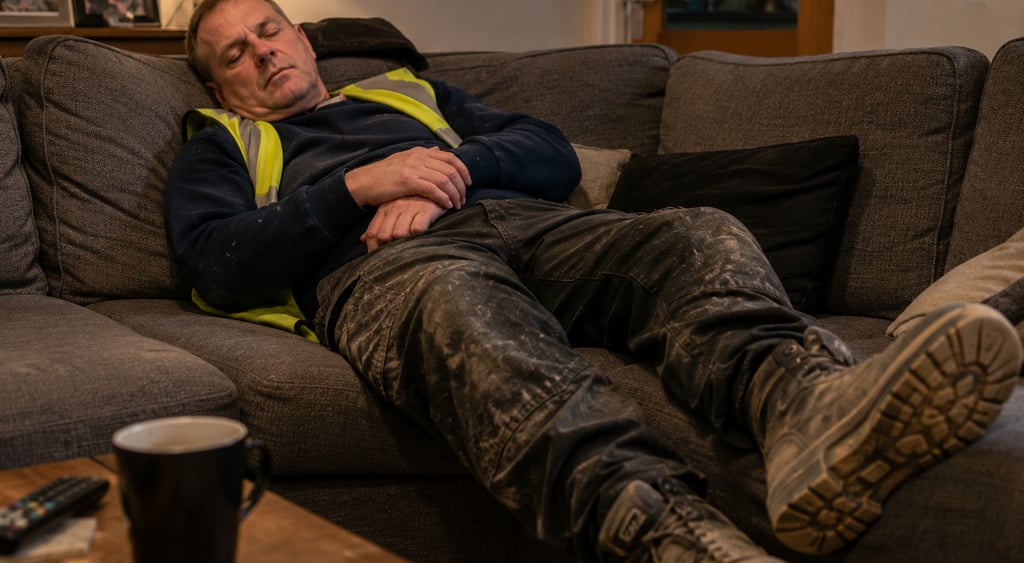
The Sofa: Where Recovery Goes to Die
You're tired. The shift was long. You get home, eat, sit down, and the next time you move properly it's to go to bed. That's a completely understandable pattern and most operators are living it.
The problem is that your body was hoping the evening was going to be its recovery window. After hours of restricted movement, it needed some circulation, some gentle movement through the hips and spine, some blood flow to the muscles that have been compressed and switched off all day.
Instead, it gets another 2–3 hours of sitting.
The sofa also tends to put you in worse positions than your cab seat. Slouched, asymmetrical, legs up, one arm on the armrest. None of it is terrible in isolation, but stacked on top of everything else, it extends the damage window right into the night.
What this means practically: you don't need to go to the gym after work. But 10–15 minutes of movement in the evening - even just walking around the block, a few stretches on the floor while the TV is on - is enough to interrupt the pattern and give your body what it was looking for.
The stretches that matter most in the evening are the same ones that undo what the cab does: hip flexor stretches, spinal rotation, hamstring work. Full guide here: [Stretches for Machine Operators: Beat Cab Stiffness](/stretches-for-machine-operators-reduce-stiffness-and-back-pain-in-the-cab)
Bed: When Sitting Becomes Lying
Eight hours in bed should be recovery time. And it mostly is - sleep is genuinely the most important thing for physical repair. But a few things are worth knowing.
Sleep position matters more than most people think. If you sleep on your side with your knees drawn up (foetal position), you're keeping your hip flexors in a shortened position for another 6–8 hours on top of everything else. Over time, this reinforces the tightness you've been building all day.
Sleeping on your back with a pillow under your knees takes the pressure off your lumbar spine and allows your hip flexors to lengthen. It's not comfortable at first if you're not used to it, but for operators with lower back issues it can make a noticeable difference within a few weeks.
Poor sleep also amplifies pain perception. If you're getting less than 6–7 hours of quality sleep, your nervous system becomes more sensitive to pain signals. That back that feels manageable on a good night's sleep feels significantly worse when you're running on 5 hours. It's not in your head - it's a measurable physiological effect.
Hydration before bed is also relevant. You've probably been under drinking during the shift and your body is dehydrated by the time you get home. Dehydrated discs and joints recover more slowly overnight. More on the hydration side here: [Why Your Back Pain Might Be a Hydration Problem](/why-your-back-pain-might-be-a-hydration-problem)
The Real Problem: It Compounds
Any one of these - the commute, the cab, the sofa, the poor sleep - your body could manage. The problem is that they stack. Every day. Five days a week. Fifty weeks a year.
The operator who's fine at 35 and falling apart at 48 didn't suddenly get unlucky. The damage accumulated slowly, and at some point it crossed a threshold where it became visible as pain, stiffness, fatigue, and loss of mobility.
The good news is that compounding works both ways. Small consistent inputs - a bit of movement here, better hydration, a few stretches before bed - also stack up. They don't feel like much in week one, but over months they shift the trajectory.
What a Better Day Actually Looks Like
You don't need to rebuild your life. You need a handful of deliberate habits dropped into the day you're already living.
| Part of the day | The problem | The fix |
| Commute in | Arriving already stiff | 5 min movement before climbing in the cab |
| In the cab | 10 hours restricted sitting | Move at every break, ankle circles while sitting |
| Lunchbreak | More sitting | Walk for 10 minutes, do 2–3 hip stretches |
| Commute home | Extending the sitting | Nothing you can do - offset it in the evening |
| Evening | Missed recovery window | 10–15 min movement while TV is on |
| Bed | Hip flexors stay short | Sleep on back with pillow under knees |
None of that is dramatic. All of it adds up.
Want a Plan That Works Around Your Day?
If your body is already giving you signals - stiff back in the morning, heavy legs, aches that used to go away overnight but don't anymore - that's your body telling you the accumulation is starting to show.
The coaching I do with machine operators is built around exactly this. Not gym programmes designed for people with free evenings and fresh bodies. A practical approach that fits into the day you're already living and targets the specific damage your working life is doing.
Message me on WhatsApp and we'll have a conversation about where you're at.
[Message on WhatsApp](00447481811959)
This post was written by stewart howard. With over 40 years split between construction sites and professional fitness training, he coaches machine operators and men over 40 who want to stay strong, mobile and capable - without it taking over their life. He's been on the tools, in the cab, and on site. He knows what real working life looks like.