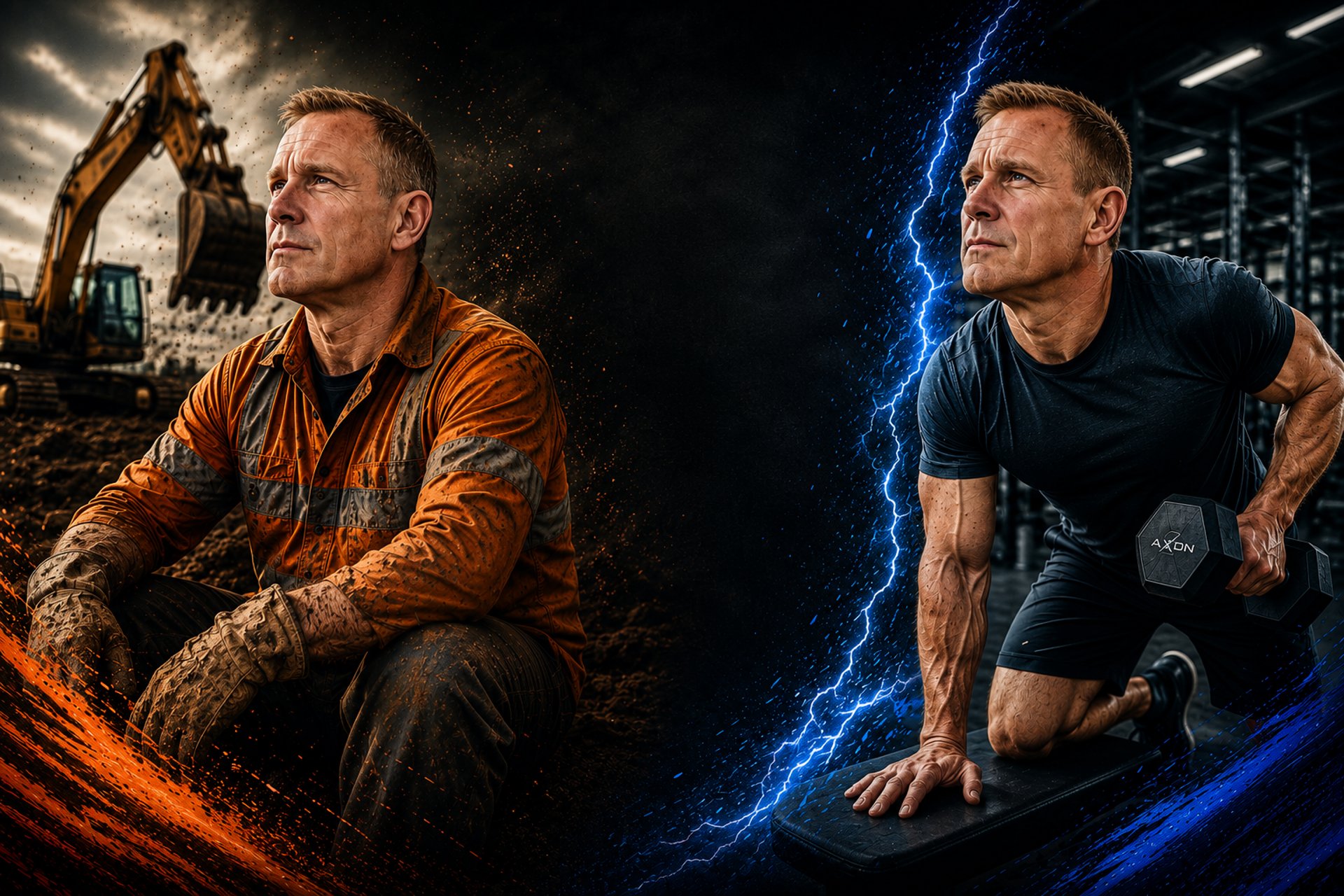
Why Working Hard Isn't the Same as Staying Fit axon fitness
stewart howard
6/9/20263 min read
Why Working Hard Isn't the Same as Staying Fit
If you've worked in construction long enough, you've probably heard it before.
"I don't need the gym. I work hard all day."
And on the surface, it sounds reasonable.
After all, construction is physically demanding.
Machine operators spend long hours concentrating in the cab. Tradesmen lift, carry, bend, twist, kneel and climb. Labourers can easily finish a shift feeling completely exhausted.
The problem is that being tired and being fit are not always the same thing.
In fact, many workers are physically exhausted while at the same time becoming less mobile, less resilient and less fit as the years go by.
Fatigue and Fitness Are Not the Same Thing
One of the biggest misconceptions in construction is believing that because work feels hard, it must automatically improve fitness.
Work creates fatigue.
Fitness is the body's ability to perform and recover.
They're not the same thing.
A machine operator may spend ten hours concentrating, sitting, absorbing vibration and dealing with mental fatigue.
A tradesman may spend the day carrying materials, kneeling on floors or working overhead.
Both may finish the day exhausted.
But exhaustion alone doesn't automatically improve:
mobility
cardiovascular fitness
strength balance
joint health
movement quality
or long-term resilience
Research has shown that physically demanding occupations do not necessarily provide the same health benefits as structured exercise. This is sometimes referred to as the "physical activity paradox."
https://bjsm.bmj.com/content/52/3/149
Repetitive Work Creates Repetitive Bodies
The body adapts to whatever it does most often.
That's why machine operators often develop:
tight hips
stiff lower backs
restricted shoulders
poor circulation
reduced movement variety
I discussed this further in:
https://www.axon.fitness/you-sit-for-16-hours-a-day
The same thing happens to tradesmen.
A tiler spends years kneeling.
A decorator spends years reaching overhead.
A groundworker spends years lifting from awkward positions.
The body becomes extremely good at those positions.
But it can gradually lose capacity everywhere else.
Work Doesn't Always Build Balanced Strength
Many workers are strong.
Very strong.
But strength developed through work is often highly specific.
You might carry heavy materials every day yet struggle to:
squat properly
touch your toes
rotate your shoulders fully
maintain good posture
or move without stiffness
That's because repetitive work loads the same tissues repeatedly.
Balanced strength training helps fill the gaps.
Research consistently shows that resistance training improves strength, mobility, bone health and physical function as we age.
https://pubmed.ncbi.nlm.nih.gov/30946242/
This isn't about bodybuilding.
It's about maintaining a body that works well.
The Cost of Constant Wear and Tear
Construction can be physically demanding without being physically protective.
Over years, many workers accept:
stiffness
aches
reduced movement
lower energy
slower recovery
as simply part of getting older.
I explored this idea further in:
https://www.axon.fitness/when-physical-decline-becomes-just-part-of-the-job
The reality is that many of these changes are not caused by age alone.
They're often the result of decades of repetitive movement, limited recovery and neglecting the basic maintenance the body needs.
What Real Fitness Looks Like for Working People
For most construction workers, fitness isn't about six-pack abs.
It's about:
getting out of the cab without stiffness
climbing ladders confidently
lifting safely
recovering faster
reducing aches and pains
having energy left after work
staying independent later in life
That's real-world fitness.
And sometimes that means doing things your job doesn't provide.
Walking.
Mobility work.
Strength training.
Better recovery habits.
Better sleep.
Regular movement outside work.
Final Thoughts
Working hard deserves respect.
Construction workers earn every penny.
But working hard and staying fit are not automatically the same thing.
Work can wear the body down just as easily as it can build it up.
The goal isn't to stop working hard.
The goal is to give your body the movement, strength and recovery it needs so you can keep doing the things that matter for years to come.
Because being exhausted at the end of the day isn't necessarily a sign of fitness.
Sometimes it's simply a sign that your body needs better support.
About the Author
I'm Stewart, founder of Axon Fitness.
I've spent over 40 years working in construction — from labouring and demolition to tiling, bathroom refurbishments and operating 360 excavators. I've also worked as a personal trainer, which gave me a deeper understanding of how physically demanding work changes the body over time.
Axon Fitness was built around a simple idea:
Helping working people stay strong, mobile and capable for the long haul.
Not bodybuilding.
Not fitness trends.
Just practical movement, strength and recovery strategies built for real life, long hours and ageing bodies.
Especially for:
machine operators
tradesmen
construction workers
and adults over 40 who want to keep moving properly for years to come.