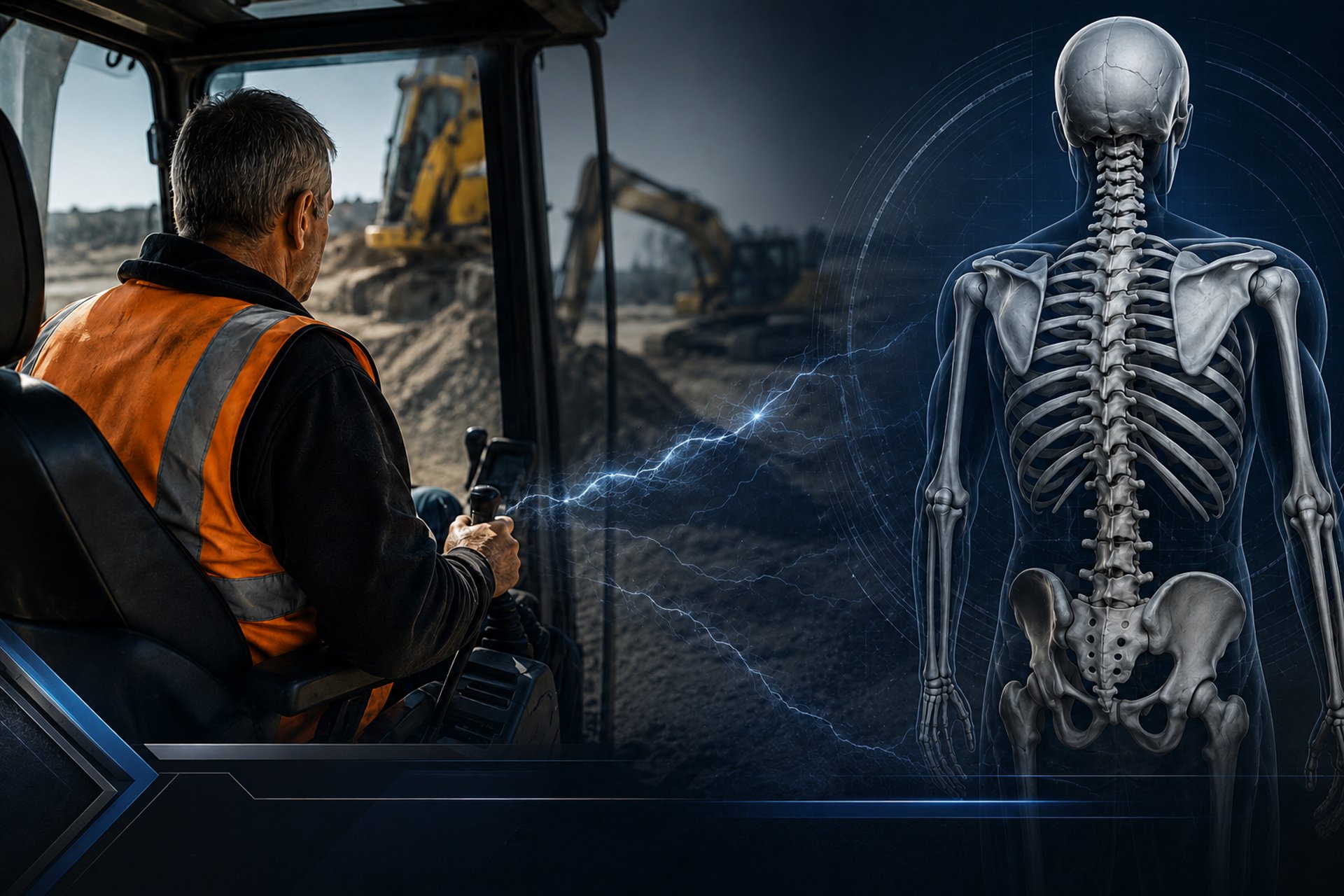
Your Skeleton Adapts to the Life You Live
Long hours sitting in machinery affects more than muscles. Learn how movement, strength training and bone loading help machine operators stay strong, mobile and capable as they age.
Stewart Axon
6/1/20263 min read
Your Skeleton Adapts to the Life You Live
Most people think about muscles when they think about fitness.
Bigger muscles.
Stronger muscles.
Tighter muscles.
But muscles are only part of the picture.
Your entire skeleton adapts to the life you repeatedly live.
And for many machine operators, drivers and tradesmen, that life often involves:
long hours sitting
reduced movement variety
vibration
less walking than people realise
and long periods of physical inactivity outside work due to fatigue.
Over time, the body adapts to all of it.
Not just through stiffness and tight hips.
Through the skeleton itself.
Bones Are Living Tissue
A lot of people still think bones are fixed structures that simply weaken with age.
But bone is living tissue that constantly remodels itself throughout life.
The body strengthens structures that are regularly used and loaded.
And when movement and loading reduce over long periods, the body adapts to that too.
Research has shown that bones respond to mechanical loading and movement by increasing strength and density over time.
https://pmc.ncbi.nlm.nih.gov/articles/PMC6279907/
That’s one reason regular movement and resistance training become increasingly important as we get older.
Sitting Changes More Than Posture
Machine operators may spend:
8 to 12 hours sitting in machinery
then another hour or more commuting
followed by evenings recovering from fatigue.
Many workers also stop moving much outside work because they’re physically drained from the week.
I talked more about this in:
https://www.axon.fitness/you-sit-for-16-hours-a-day
The problem is that the body adapts to reduced movement surprisingly quickly.
Less walking.
Less climbing.
Less carrying.
Less impact through the skeleton.
Over years that can contribute to:
reduced mobility
lower strength
poorer balance
increased stiffness
and declining physical resilience.
Especially after 40.
Why Resistance Training Helps Bone Strength
One of the most overlooked benefits of strength training is what it does for the skeleton.
When muscles contract, they pull on tendons.
Those tendons attach to bone.
That pulling force creates stress through the skeleton, which helps stimulate bone remodelling and strengthening over time.
Research consistently shows resistance training can help improve or maintain bone density, particularly as people age.
https://pubmed.ncbi.nlm.nih.gov/30946242/
This doesn’t mean people need bodybuilding routines or fancy gym programmes.
Simple strength work still matters:
squats
carries
pushing
pulling
lifting awkward loads
climbing
loaded movement
The body responds to being used.
Heavy Work Does Load the Skeleton
Traditional trades often involved more natural bone loading than modern seated work.
Years ago many workers:
carried materials constantly
climbed more
lifted awkward loads regularly
and moved far more throughout the day.
That physical loading placed stress through the skeleton.
Modern machinery has reduced strain in many positive ways.
But one downside is that some operators now spend huge parts of the day relatively motionless.
That’s one reason movement outside the cab becomes important.
Even short movement breaks and strength work can help offset some of the stiffness and inactivity that builds over time.
I covered some simple movement ideas here:
https://www.axon.fitness/stretches-for-machine-operators-reduce-stiffness-and-back-pain-in-the-cab
Staying Structurally Strong Matters
This isn’t about looking impressive.
It’s about staying physically capable later in life.
Strong bones, healthy joints and good movement matter for:
balance
coordination
injury reduction
mobility
independence
and staying active as you age.
The body adapts to whatever you repeatedly ask it to do.
If you stop loading it, stop moving it and spend years mostly sitting, the body adapts accordingly.
But the opposite is also true.
Consistent movement, resistance training and regular loading can help the body remain stronger, more capable and more resilient for far longer than many people realise.
About the Author
I’m Stewart, founder of Axon Fitness.
I’ve spent over 40 years working in construction — from labouring and demolition to tiling, bathroom refurbishments and operating 360 excavators. I’ve also worked as a personal trainer, which gave me a deeper understanding of how physically demanding work changes the body over time.
Axon Fitness was built around a simple idea:
Helping working people stay strong, mobile and capable for the long haul.
Not bodybuilding.
Not fitness trends.
Just practical movement, strength and recovery strategies built for real life, long hours and ageing bodies.
Especially for:
machine operators
tradesmen
construction workers
and adults over 40 who want to keep moving properly for years to come.