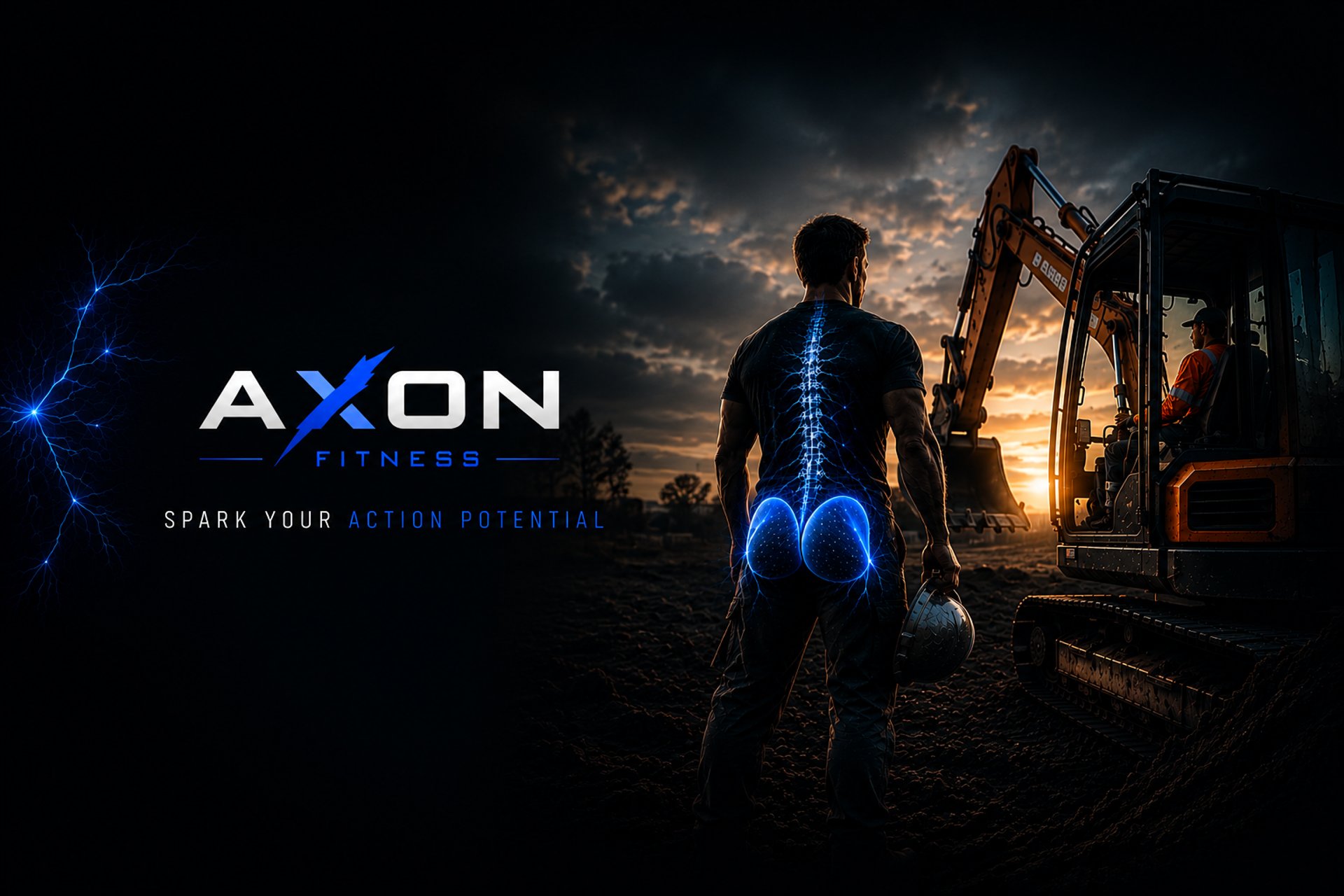
Why Machine Operators Need Strong Glutes
stewart howard
6/22/20263 min read
Why Machine Operators Need Strong Glutes
Most machine operators think their lower back is the problem.
The stiffness.
The aching.
The feeling that it takes a few minutes to straighten up after getting out of the cab.
But often the lower back is only part of the story.
The real problem may be that one of the most important muscle groups in the body has gradually stopped doing its job.
Your glutes.
Key Takeaways
Long hours sitting in machinery can reduce glute activation over time.
Weak glutes often contribute to lower back tightness, hip discomfort and poor movement.
Strong glutes help support balance, posture and lower body strength.
Strength training helps maintain muscle, mobility and long-term physical capability.
Small amounts of regular movement are often more effective than occasional hard efforts.
Looking after your glutes is about staying capable, not building a bigger backside.
The Muscle Group Most People Forget About
The glutes are the muscles around your backside and hips.
They are the largest muscle group in the body and play a major role in:
supporting the pelvis
stabilising the lower back
controlling hip movement
helping you walk, climb and lift
maintaining balance and posture
When they are strong and functioning properly, movement feels easier.
When they are weak or inactive, the body starts looking elsewhere for help.
That's where problems often begin.
Sitting All Day Changes How The Body Works
Machine operators can spend long hours sitting in the same position.
Add in commuting, evenings at home and years spent in machinery, and the amount of time spent sitting can become significant.
I discussed this in more detail here:
https://www.axon.fitness/you-sit-for-16-hours-a-day
The body adapts to whatever it does repeatedly.
Long periods sitting can contribute to:
reduced glute activation
tighter hip flexors
restricted hip movement
reduced lower body strength
increased lower back compensation
Many operators recognise the feeling.
You stand up after a shift and it feels like you're unfolding yourself.
The body becomes efficient at sitting.
Unfortunately, it can also become less efficient at moving.
When The Glutes Stop Working, Something Else Takes Over
The body is incredibly good at finding ways to compensate.
If the glutes aren't contributing properly, other muscles often try to take over.
Usually that means:
the lower back works harder
the hamstrings become overloaded
the hips become tighter
movement becomes less efficient
Over time this can contribute to:
lower back discomfort
hip tightness
poor posture
reduced stability
and movement that feels increasingly restricted
Research has shown that prolonged sitting can reduce glute muscle activity and alter normal movement patterns.
https://pubmed.ncbi.nlm.nih.gov/28929970/
Why Strong Glutes Matter More As You Get Older
After the age of 40, maintaining muscle becomes increasingly important.
Loss of muscle mass and strength is a normal part of ageing.
Researchers refer to this process as sarcopenia.
https://www.nia.nih.gov/health/sarcopenia
The good news is that strength training and regular movement can help slow this process significantly.
Strong glutes help support:
balance
mobility
walking efficiency
lifting ability
lower back health
physical independence
This isn't about building a bigger backside.
It's about maintaining a body that continues to function well.
Strength Training Helps More Than Muscles
One of the benefits of strength training is that it improves more than muscle strength.
As I discussed in:
https://www.axon.fitness/your-skeleton-adapts-to-the-life-you-live
When muscles contract, they pull on tendons, which place force through the skeleton.
This helps stimulate adaptation throughout the body.
Strong glutes contribute to:
stronger hips
improved movement patterns
better posture
greater stability
and improved physical resilience
Research consistently shows resistance training improves physical function and quality of life as we age.
https://pubmed.ncbi.nlm.nih.gov/30946242/
This isn't about spending hours in the gym.
It's about maintaining the strength and movement quality needed to keep working and living well.
Simple Ways To Wake The Glutes Up Again
The good news is that complicated exercises aren't required.
Simple movements performed consistently can make a significant difference.
Examples include:
walking
glute squeezes during breaks
bodyweight squats
step-ups
bridges
hill walking
resistance training
Small amounts of movement performed regularly often beat occasional heroic efforts.
Final Thoughts
Machine operators spend years developing skills that allow them to work machinery efficiently and safely.
Unfortunately, the body adapts to sitting just as efficiently.
Strong glutes aren't about aesthetics.
They're about maintaining the strength, stability and movement quality needed to stay capable for the long haul.
If you've noticed increasing lower back stiffness, tight hips or difficulty moving after long shifts, it may not be your back that's causing the problem.
It could simply be that your glutes have forgotten how to do theirs.
About the Author
I'm Stewart, founder of Axon Fitness.
I've spent over 40 years working in construction — from labouring and demolition to tiling, bathroom refurbishments and operating 360 excavators. I've also worked as a personal trainer, which gave me a deeper understanding of how physically demanding work changes the body over time.
Axon Fitness was built around a simple idea:
Helping working people stay strong, mobile and capable for the long haul.
Not bodybuilding.
Not fitness trends.
Just practical movement, strength and recovery strategies built for real life, long hours and ageing bodies.
Especially for:
machine operators
tradesmen
construction workers
and adults over 40 who want to keep moving properly for years to come.
Disclaimer
This article is intended for educational purposes only and is not a substitute for individual medical advice.